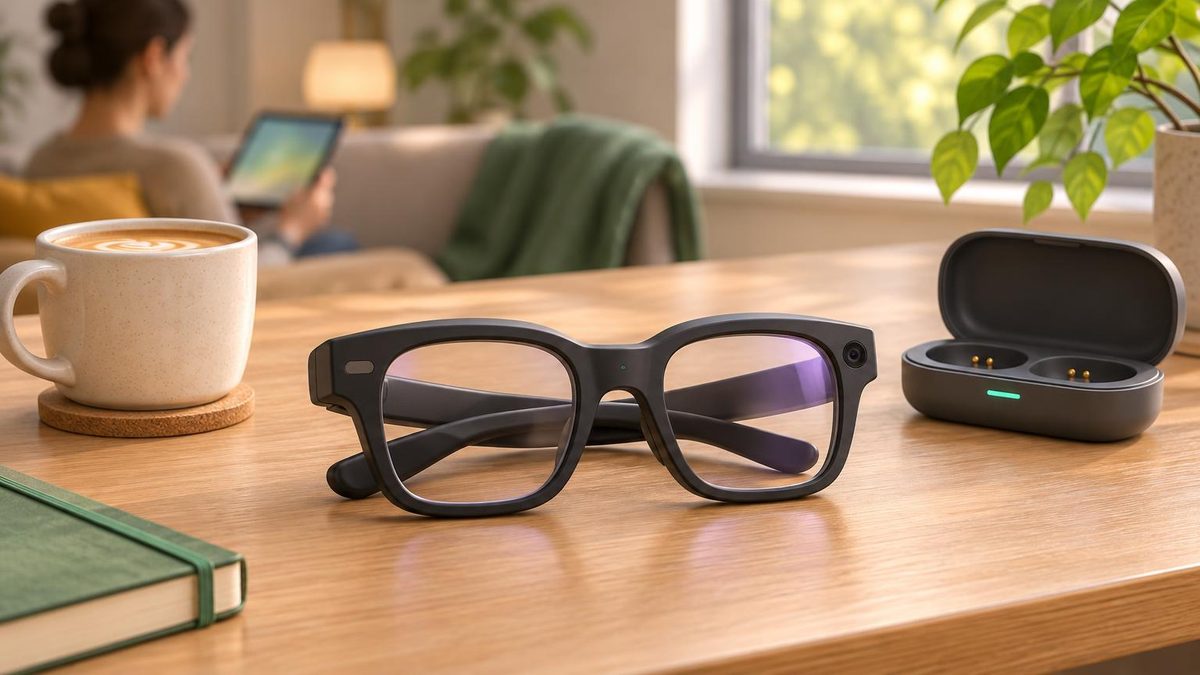
The best AI smart glasses for most people right now are the Ray-Ban Meta (Gen 3), with Samsung's new Gemini-powered Intelligent Eyewear as the strongest alternative once it ships on December 10, 2026. If you want a screen in the lens, the Meta Ray-Ban Display is still the most complete option, and the Even Realities G2 is the pick if you want a display but no camera.
The category grew fast in 2026: Meta now sells camera, audio-only, sports and display glasses, Google and Samsung finally have a rival, and smaller firms cover the corners Meta ignores. Smart glasses are only one branch of the wider category, so if you are still deciding what kind of device you want, start with our guide to the best AI gadgets you can buy right now.
The short version
- Ray-Ban Meta (Gen 3) starts at $449 and is the safest buy, but the Gen 2 at $349 does almost the same job for $100 less.
- Samsung Intelligent Eyewear starts at $395, weighs about 41 g and has no display. Pre-orders are open, and it goes on sale in the US and South Korea on December 10, 2026.
- Meta Ray-Ban Display costs $799 with the Neural Band wristband and is the only mainstream glasses with a full-color screen in the lens.
- Meta's new Muse agent does not run on its glasses yet. Meta AI on the glasses now uses the Muse Spark models, but the full Muse agent is still "coming in the months ahead".
- Apple, Amazon and OpenAI have not shipped glasses. Apple is reported to be aiming for 2027.
How we picked these AI glasses
We looked for glasses you can buy today or order with a firm ship date, with a built-in AI assistant, a clear price and published specs. Then we weighed assistant usefulness, comfort and weight, battery life, prescription support and privacy.
To be upfront about method: this list is built from company spec sheets, pricing pages, press releases and published reviews from outlets such as Engadget, Gizmodo, Tom's Guide and TechCrunch, not from our own time with the glasses. Where a number comes from a single report, we say so. Announced-only products sit in "Coming soon" further down.
The best AI smart glasses at a glance
| Glasses | Starts at | Display | Camera | Assistant | Best for |
|---|---|---|---|---|---|
| Ray-Ban Meta (Gen 3) | $449 | No | 12MP | Meta AI | Most people |
| Samsung Intelligent Eyewear | $395 | No | 12MP | Gemini | Android and Google users |
| Meta Ray-Ban Display | $799 | Color, one eye | Yes | Meta AI | Glanceable info |
| Even Realities G2 | $599 | Green, both eyes | None | Even AI | Work and privacy |
| Oakley Meta Vanguard | $499 | No | Yes | Meta AI | Runners and cyclists |
| Rokid Glasses | $699 | Green, both eyes | 12MP | Gemini or ChatGPT | Choosing your AI |
| Brilliant Labs Halo | $399 | Small color OLED | Yes | Noa | Tinkerers |
| Xreal Aura | $1,279 | Full XR, both eyes | Yes | Gemini | Big virtual screens |
The 8 best AI glasses, ranked
Ray-Ban Meta (Gen 3)
Best for: most people who want camera glasses that just work
- Price: starts at $449 (Wayfarer), Zena and Aviator from $529
- Subscription: none required; Meta is trialing paid Meta One storage plans
- Battery: up to 9 hours, about 50 hours with the case (Meta)
- Weight: about 51.5 g (Engadget)
Meta launched the third generation at Connect on September 23, 2026. It is a refinement: a slimmer frame, a sixth microphone for clearer calls, a customizable action button for Meta AI, and an hour more battery than Gen 2. The 12MP camera records 3K video. Meta AI on the glasses now runs on Meta's Muse Spark models, which Engadget's reviewer said made conversations feel more natural with fewer errors. The catch is value. Engadget scored it 7.3 out of 10 and called the upgrades minor for the money, noting that the Gen 2 is still sold at $349. The temples also cannot be adjusted at home.
Get it if you want the most polished, widely available AI camera glasses with the most frame styles. Skip it if you can live with an hour less battery: the Gen 2 at $349 is the better deal.
Samsung Intelligent Eyewear (Gentle Monster and Warby Parker)
Best for: Android and Google users who want Gemini in a normal-looking frame
- Price: Warby Parker from $395, Gentle Monster $449 to $489
- Availability: pre-orders open now, on sale December 10, 2026 in the US and South Korea
- Battery: up to 9 hours, up to 72 hours with the case (Samsung)
- Weight: about 41 g without prescription lenses
Samsung does not give these glasses a catchy brand name: its press release calls them intelligent eyewear, sold as Gentle Monster Intelligent Eyewear and Warby Parker Intelligent Eyewear, with 30 designs between them. There is no display. You talk to Gemini, it hears you through four microphones and answers through two open-ear speakers, and a 12MP HDR camera lets it see what you see. Samsung and Google list landmark and object questions, Google Maps walking directions, live speech translation (Google says more than 70 languages), and notification summaries. They work with recent Galaxy and Pixel phones and with iPhones that have at least 6 GB of RAM (Google's list starts at the iPhone 13 Pro), but only with US and South Korean Google accounts at launch. Early hands-on reports from Gizmodo and SammyGuru say they feel lighter than Meta's glasses; no full reviews exist yet.
Get it if you live in Google's apps and want the strongest privacy promises in this class. Skip it if you are outside the US or South Korea, or you want a screen.
Meta Ray-Ban Display with Meta Neural Band
Best for: people who want messages, maps and answers in front of their eyes
- Price: $799 with the Neural Band, £749 in the UK, from €899 in Germany, France and Italy
- Display: 600 x 600 full-color, right lens only, about 20 degree field of view
- Battery: about 6 hours mixed use; Neural Band about 18 hours (Meta)
- Prescription: -4.00 to +4.00 only
This is still the only mainstream AI glasses with a proper color screen. A small display in the right lens shows messages, walking directions, live captions, a camera viewfinder and Meta AI answers, and the Neural Band, a wristband that reads tiny muscle signals in your wrist, lets you scroll and click with finger pinches. Since 2026 updates it also supports neural handwriting (write with your finger to reply silently, early access in the US and Canada), and Meta AI on the Display moved to the Muse Spark models in July 2026. The trade-offs are real: 69 g is heavy for glasses, battery life is about six hours, and the prescription range is narrow. Since September 2026 it is also sold online in the US and in the UK, Canada and parts of Europe.
Get it if a screen is the point and $799 does not scare you. Skip it if you need a strong prescription or want all-day comfort.
Even Realities G2
Best for: meetings, presentations and anyone who does not want a camera on their face
- Price: starts at $599; optional R1 control ring extra
- Subscription: none, according to Even Realities
- Weight: 36 g, IP65 dust and water resistance
- Prescription: -12.00 to +12.00
The G2 takes the opposite approach to Meta: a display, but no camera at all. Even Realities says that is by design, so nobody wonders whether they are being recorded. A green text display in both lenses shows a teleprompter, turn-by-turn directions, notifications, a calendar and real-time translation in 35 languages. The headline feature is Conversate, which transcribes a conversation, surfaces context cues while you talk and writes a summary afterwards in the app. You can ask questions by saying "Hey, Even". The company claims up to two days of battery and seven extra charges from the case. Reviews are split: Tom's Guide was enthusiastic, while Wareable found the software thin for the price.
Get it if you want a heads-up display for work, or you need a strong prescription. Skip it if you want photos, video or an assistant that can see.
Oakley Meta Vanguard
Best for: runners and cyclists who want hands-free video and stats
- Price: $499 in the US
- Battery: up to 9 hours, plus 36 hours from the case (Meta)
- Durability: IP67 rating
- Works with: Garmin watches and Strava
The Vanguard is Meta's sports wraparound, built for training rather than the office. It pairs with compatible Garmin devices and with Strava through the Meta AI app, so you can ask for pace or heart rate by voice and record point-of-view video without stopping. It has the same Meta AI as the Ray-Ban models and is sealed against sweat and rain. Reviews are mixed on the fitness side: Tom's Guide praised the Garmin and Strava integration, while T3 called it clunky and manual in practice and said clip length and video quality cannot replace an action camera. The cheaper Oakley Meta HSTN covers the basics without the sports extras.
Get it if you train outdoors and already use Garmin or Strava. Skip it if you want glasses you can also wear to dinner.
Rokid Glasses
Best for: people who want a display, a camera and a choice of AI model
- Price: $699 on Rokid's store (checked November 28, 2026)
- Display: green monochrome micro-LED in both lenses
- Camera: 12MP
- Weight: about 49 g
Rokid's display glasses sit between Meta's two camps: a camera like the Ray-Bans and a heads-up display like the Even G2, in a frame that weighs less than the Meta Ray-Ban Display. A March 2026 update to the international version lets you pick the AI model in the Hi Rokid app, with Gemini and ChatGPT both on the list, and some reports say DeepSeek and Qwen too. Reviewers report translation in many languages (one outlet says 89). Tom's Guide called it a real Meta Ray-Ban Display rival, though prescription lenses are pricey. Rokid also sells a cheaper display-free model, the Rokid AI Glasses Style, which launched globally in January 2026 at $299.
Get it if you want ChatGPT or Gemini in display glasses today. Skip it if you want the polish and retail support of Meta or Samsung.
Brilliant Labs Halo
Best for: developers and tinkerers who want open-source glasses
- Price: $399 on Brilliant Labs' store (launch pre-orders were $299)
- Shipping: batches began shipping in October 2026 after long delays
- Battery: up to 14 hours (Brilliant Labs)
- Weight: just over 40 g
Halo is the odd one out, and that is the appeal. The hardware and software are open source, a small color OLED display sits in your peripheral vision, and the assistant, called Noa, responds to what the glasses see and hear and can keep a running memory of people, conversations and things you saw. There is even a game layer, Narrative, that turns walking around into a pixel-art adventure. Brilliant Labs says AI processing happens through your phone and that no audio or video is stored in the cloud. GamesBeat's October 2026 hands-on found the novelty faded, and its display lens had come loose in the box.
Get it if you want to hack on your glasses and like an open platform. Skip it if you want a finished consumer product.
Xreal Aura
Best for: big virtual screens, gaming and Android apps on the go
- Price: $1,279 (12 GB, 256 GB), launch price $1,099 through December
- Availability: US, Canada, Japan and South Korea, shipping from mid-November 2026
- Weight: 95 g, wired to a compute puck
- Platform: Android XR with Gemini
Formerly Project Aura, this is the first Android XR glasses from Xreal and a different kind of device from everything above. It is not all-day eyewear: the glasses connect by cable to a puck with a Qualcomm Snapdragon Reality Elite chip, for sessions of movies, games, Google Play apps and multi-monitor work. Road to VR reports Sony micro-OLED panels at 1920 x 1200 per eye and up to 120 Hz, plus a camera for hand tracking and Gemini's view of your surroundings. Gemini is built in for questions about what is on screen and around you. Xreal has not published a battery runtime.
Get it if you want a portable big screen with Android apps and Gemini. Skip it if you want glasses for everyday wear.
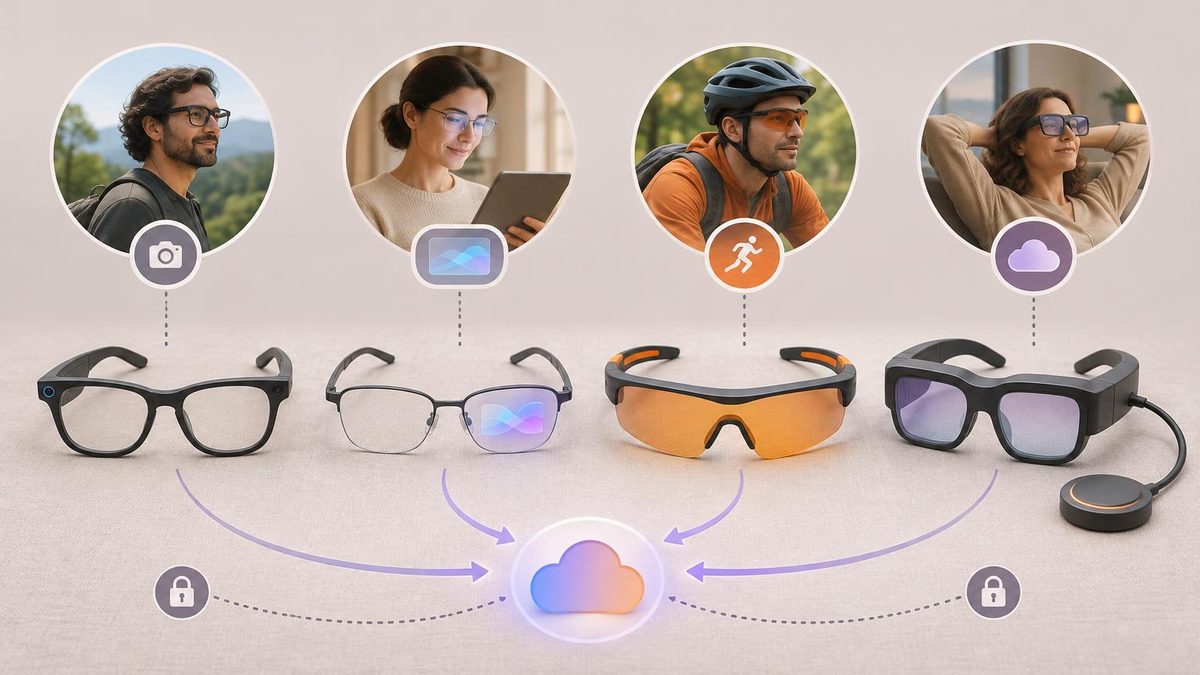
Cheaper Meta options worth knowing
The best Meta glasses may not be the newest. The Ray-Ban Meta (Gen 2) is still sold at $349, according to Engadget, with 8 hours of battery against Gen 3's 9. The own-brand Meta Adventurer starts at $249. The Ray-Ban Meta Audio, from $349, drops the camera entirely: Meta claims 12 hours of battery and a 43 g frame, a good fit if you want an assistant and open-ear audio without filming anyone.
What they really cost: frames, lenses and subscriptions
The sticker price is only the start. Prescription lenses, rings and paid features add up over the two or more years you will wear a pair.
| Glasses | Starts at | Prescription | Required subscription | Paid extras |
|---|---|---|---|---|
| Ray-Ban Meta (Gen 3) | $449 | Yes, price varies by retailer | None | Meta One storage plans (trial), hearing enhancement $149.99 |
| Samsung Intelligent Eyewear | $395 | Yes; one Warby Parker buyer reports $495 with a basic prescription | None listed | Guided Vision and Aira services may need a subscription |
| Meta Ray-Ban Display | $799 | -4.00 to +4.00 only | None | Neural Band included |
| Even Realities G2 | $599 | -12.00 to +12.00, extra cost | None | R1 ring ($179 with the glasses in Even's current deal) |
| Oakley Meta Vanguard | $499 | Check with retailer | None | Garmin watch sold separately |
| Rokid Glasses | $699 | Prescription frame insert | None announced | Charging case $99 |
| Brilliant Labs Halo | $399 | Prescription and sun lens options | None announced | None announced |
| Xreal Aura | $1,279 ($1,099 launch) | Prescription inserts | None | Controller $99, keyboard $79 |
The good news: none of these glasses needs a monthly fee to work. The assistants behind them are a different story. Gemini, Meta AI and ChatGPT all have free tiers with paid upgrades on the phone, and how those plans affect wearables is changing fast. We compare them in our Gemini vs Meta AI vs ChatGPT wearables breakdown, and if a monthly bill is a dealbreaker, see our list of AI gadgets that work without a subscription.
Does Meta's Muse run on the glasses yet?
Not fully. Meta uses the name twice. Muse Spark is a family of AI models, and since July 27, 2026 it powers Meta AI on the Ray-Ban Display; Engadget says the Gen 3 uses it too. Muse is also the name of Meta's personal AI agent, which can plan and carry out tasks across apps and shops. That agent runs in the Muse app, on WhatsApp, on the web and on the Mac. On glasses, Meta says it is coming "in the coming months", and Engadget's November review notes a Meta support page that labels it beta. For the full picture, read what Meta's Muse agent actually is and where it runs.
Coming soon: announced, not ranked
- Muse on Meta glasses: promised for "the coming months", no date. Meta's separate Muse Charm pocket device is due before the December holidays, with no official price.
- Samsung glasses with a display: 9to5Google, citing Korean supplier reports, says Samsung's first color-display glasses may launch in late 2027. Not announced.
- Apple glasses: Bloomberg's Mark Gurman reports Apple plans to unveil camera glasses without a display at WWDC in June 2027 and ship later that year. Not announced.
- Amazon glasses: a consumer model with a display, codenamed Jayhawk, was reported for late 2026 or early 2027. Amazon has announced nothing as of November 28, 2026.
- OpenAI: its first device is reported to be a speaker-like gadget for 2027 at the earliest, with glasses not before 2028. See what we know about the OpenAI and Jony Ive device.
Privacy check: every camera pair on this list has a recording light, and Samsung says its camera shuts off if the light is covered. Before you buy, read our guide to privacy and always-listening AI wearables, and check the training opt-outs in the companion app.
Which AI glasses should you buy?
- You want the safe choice: Ray-Ban Meta (Gen 3), or Gen 2 at $349 if you want to save money.
- You use Android, Gmail and Google Maps all day: Samsung Intelligent Eyewear, once it ships on December 10. Our Samsung Intelligent Eyewear vs Meta Ray-Ban Display comparison covers the trade-offs in detail.
- You want a screen: Meta Ray-Ban Display for color and the Neural Band; Even Realities G2 if you also want no camera and a strong prescription.
- You train outdoors: Oakley Meta Vanguard.
- You want to choose ChatGPT or Gemini yourself: Rokid Glasses.
- You like to tinker: Brilliant Labs Halo.
- You want a portable giant screen: Xreal Aura.
FAQ
What are the best AI glasses right now?
For most people, the Ray-Ban Meta (Gen 3) from $449, or the Gen 2 at $349. Samsung's Gemini glasses from $395 are the main alternative from December 10, 2026, and the Meta Ray-Ban Display at $799 is the best option with a built-in screen.
Do Samsung's AI glasses have a display?
No. Samsung's first intelligent eyewear has a camera, microphones and speakers, and Gemini answers by voice. A display model is only rumored, reportedly for late 2027.
Do AI glasses need a subscription?
None of the glasses on this list needs a monthly fee for its core features. Some extras cost money, such as Meta's $149.99 hearing enhancement or Aira on Samsung's glasses.
Can you get AI glasses with prescription lenses?
Yes, all of these support prescriptions in some form, but ranges vary: the Meta Ray-Ban Display covers -4.00 to +4.00, the Even Realities G2 -12.00 to +12.00.
More on AI gadgets
Sources
Checked on November 28, 2026.
- Samsung Newsroom: Samsung Announces December Release for Intelligent Eyewear
- Google: See our intelligent eyewear lineup and pre-order your pair
- Meta: Everything We Announced at Meta Connect 2026
- Engadget: Everything announced at Meta Connect 2026
- Engadget: Ray-Ban Meta (Gen 3) review
- Meta: New Features for Meta Ray-Ban Display
- Meta: Meta Ray-Ban Display gets Threads and a new version of Meta AI
- UploadVR: Meta Ray-Ban Display officially announced
- Gizmodo: Samsung and Google smart glasses hands-on
- SammyGuru: Samsung Intelligent Eyewear hands-on
- Even Realities: Even G2
- T3: Oakley Meta Vanguard review
- Yanko Design: Rokid's smart glasses let you pick your AI
- GamesBeat: Brilliant Labs is betting on gamification
- TechCrunch: Xreal Aura is a new wired headset powered by Android XR
- Road to VR: Xreal Aura launches today
- Futurum: Meta's Muse enters UK
- 9to5Google: Samsung's first Android XR glasses with a color display may launch in late 2027
- PetaPixel: Apple's smart glasses could arrive by the end of 2027
- Tom's Guide: Amazon could reportedly launch its own AR glasses
- Engadget: Meta's Muse Charm will reportedly cost $300
- MacRumors: Jony Ive's first OpenAI device will be a smart speaker with camera
- Brilliant Labs: Halo
- Rokid: official store