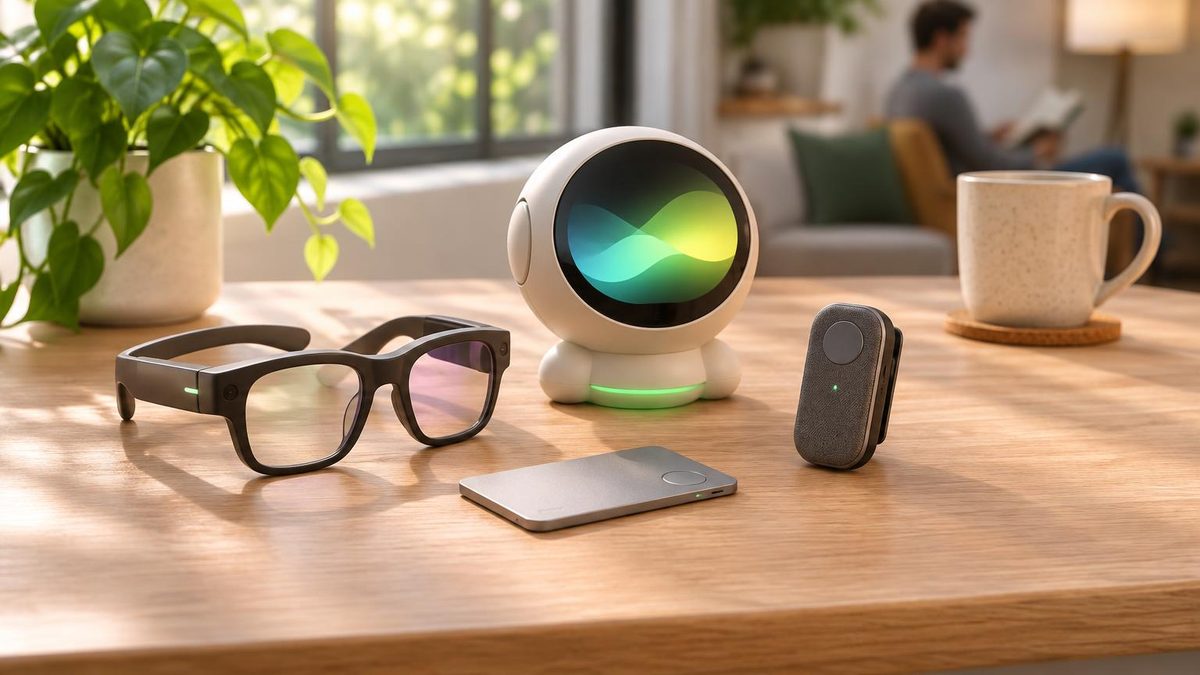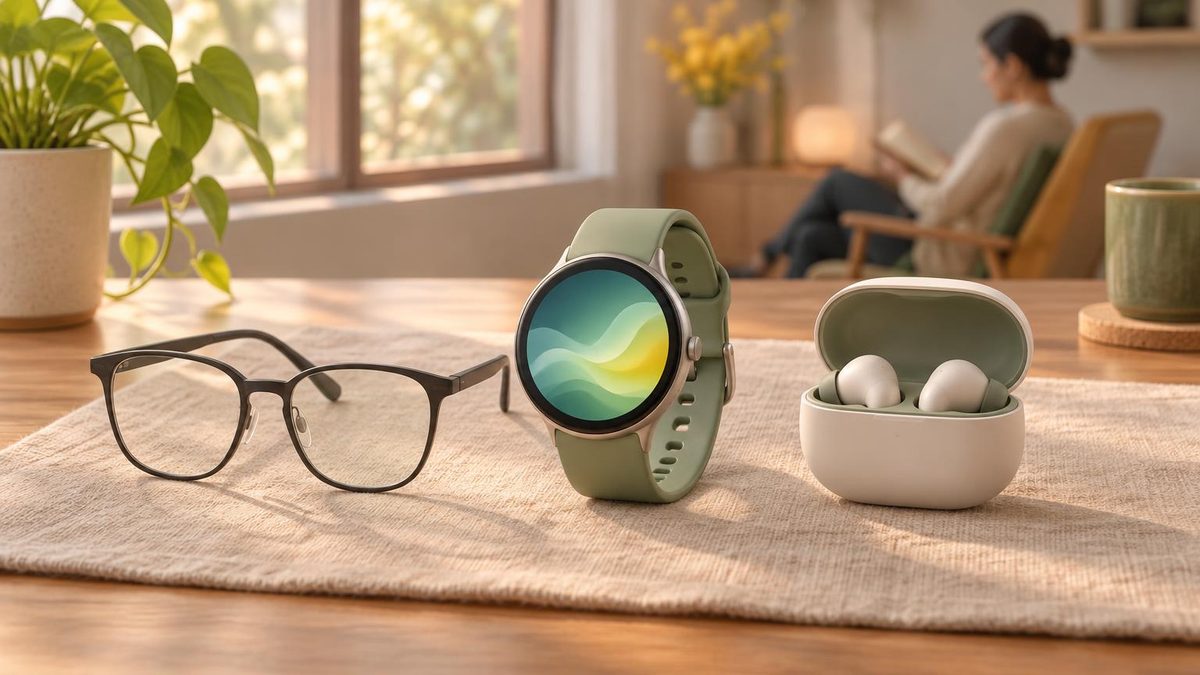
For wearables in late 2026, Gemini is the best all-round assistant because it officially runs on the most kinds of devices: Android watches, Pixel Buds and, from December 10, Samsung's new AI glasses. Meta AI is the most mature assistant on smart glasses, and ChatGPT, for all its strengths on the phone, still has no official wearable of its own.
That last point surprises people. ChatGPT shows up on your face or in your ears only through other companies' hardware or through the phone app. OpenAI's own device is not out yet. So the real question is less "which AI is smartest" and more "which AI is actually built into the thing you wear". If you are still choosing a device, our guide to the best AI gadgets covers the hardware side.
The short version
- Gemini runs on Wear OS watches, Pixel Buds, Samsung's Intelligent Eyewear (from $395, ships December 10, 2026) and Xreal's Aura. Its glasses come with the strongest written privacy promises of the three.
- Meta AI runs on every Ray-Ban Meta, Oakley Meta and Meta-branded glasses, including the $799 Meta Ray-Ban Display. It now uses Meta's Muse Spark models, but the Muse agent itself is not on glasses yet.
- ChatGPT has no official watch or glasses app. You get it through third-party gear like Rokid glasses, Nothing earbuds (with a Nothing phone) or the Omi pendant, or through the phone app with any earbuds.
- All three are free to start. Gemini's paid plans start at a reported $7.99 a month, ChatGPT Plus is $20, and Meta has no general paid tier for Meta AI, only extras like hearing enhancement and storage.
Gemini vs Meta AI vs ChatGPT at a glance
| Gemini | Meta AI | ChatGPT | |
|---|---|---|---|
| Glasses | Samsung Intelligent Eyewear, Xreal Aura, Rokid (option) | All Ray-Ban Meta, Oakley Meta, Meta glasses, Meta Ray-Ban Display | Rokid (option) |
| Watches | Wear OS 4 and later; on-device on Pixel Watch 5 | None | No official app |
| Earbuds | Pixel Buds Pro 2 and Pixel Buds 2a | None (camera-free Ray-Ban Meta Audio glasses instead) | Nothing earbuds with a Nothing phone; any earbuds via the app |
| Dedicated AI gadgets | None from Google | Muse Charm due before the holidays, unpriced | Omi pendant; OpenAI's own device not before 2027 (reported) |
| Sees through a camera | Yes, on glasses | Yes, on camera glasses | Only on third-party glasses |
| Free to use | Yes | Yes | Yes, with limits |
| Main paid plan | Google AI Pro, $19.99 a month (reported) | None for the assistant | ChatGPT Plus, $20 a month |
Where each assistant runs today
Gemini has the widest official reach. Google brought Gemini to Wear OS watches in July 2025, starting with models from Pixel, Samsung, OPPO, OnePlus and Xiaomi running Wear OS 4 or later. In August 2026 the Pixel Watch 5 became the first Pixel Watch to run what Google calls Gemini Intelligence on the watch itself, with proactive suggestions and offline commands for timers, alarms and workouts, according to 9to5Google. Google also said Pixel Buds Pro 2 and Pixel Buds 2a would get Gemini voice controls for audio settings in a September update. On glasses, Gemini powers Samsung's Intelligent Eyewear, made with Gentle Monster and Warby Parker, and Xreal's tethered Aura. Rokid's display glasses let you pick Gemini as well.
Meta AI lives almost entirely on Meta's glasses: Ray-Ban Meta Gen 2 and Gen 3, the camera-free Ray-Ban Meta Audio, Oakley Meta HSTN and Vanguard, the own-brand Meta glasses such as the $249 Meta Adventurer, and the Meta Ray-Ban Display. Meta's newer Muse agent, which can plan and finish tasks like shopping, runs in the Muse app, WhatsApp, the web and on the Mac. Meta says Muse is coming to its glasses "in the coming months", and a pocket device for it, Muse Charm, is due before the December holidays with no official price. We explain the difference in our guide to Meta Muse vs Meta AI, and the gadget itself in our Muse Charm explainer.
ChatGPT is the outlier. We found no official OpenAI app for Apple Watch or Wear OS; OpenAI community staff have said there is no timeline for a native watch app. Instead, ChatGPT reaches wearables through partners. Nothing's earbuds can start a ChatGPT conversation with a pinch, but only when paired with a Nothing phone. Rokid's glasses offer ChatGPT as one of their AI models. The Omi pendant ($179 list on Omi's own store) runs its conversations through ChatGPT. On anything else, you are using the phone app with your earbuds. OpenAI's own hardware is not out: The Information reports the first device is a speaker-like gadget with a camera, due February 2027 at the earliest. See what we know about the OpenAI and Jony Ive device.
One twist: Apple's new Siri AI, which arrived in beta with iOS 27 in September 2026, runs on Apple Foundation Models that Apple says were "custom-built in collaboration with Google and its Gemini models". It is still Siri, not Gemini, and it is English-only at launch and not available on iPhone or Apple Watch in the EU.
Edge: Gemini, because it is the only one of the three officially built into glasses, watches and earbuds.
Vision: which assistant can see what you see
Camera glasses are where wearable AI feels most new: you look at a sign, a plant or a menu and ask about it.
Meta AI has done this the longest. On Ray-Ban Meta glasses you can ask about what is in front of you, and Live AI keeps a continuous camera session running for back-and-forth conversation, though Engadget's Gen 3 review notes it drains the battery faster. Meta says its Muse Spark models, which reached the Display in July 2026 and power the Gen 3, improved how well Meta AI understands what you are looking at. The Meta Ray-Ban Display adds a screen to show answers. Meta also announced shopping features that identify products and prices.
Gemini's camera work on glasses starts in earnest on December 10, when Samsung's glasses ship. Samsung and Google say you can identify landmarks and objects, ask follow-up questions, photograph a whiteboard and have Gemini summarize it into Samsung Notes, and translate a menu. Gizmodo's early hands-on found Gemini's camera answers "satisfactory", which is honest rather than glowing. On Android, Google also offers Guided Vision, spoken scene descriptions for blind and low-vision users.
ChatGPT can only see through a wearable if a third party pipes the camera to it. Rokid's glasses let you choose ChatGPT or Gemini for vision questions, according to reviews, but this is a less polished setup: Digital Camera World called Rokid's multi-model approach "a little byzantine".
Edge: Meta AI, because it has the longest track record on camera glasses and the only display-equipped mainstream option.
Translation and languages
Live translation is one of the few AI glasses features people keep using after the novelty fades, so language coverage matters.
Google says live speech translation on Samsung's glasses covers more than 70 languages with automatic language detection, using Google Translate. Gizmodo's hands-on said translation was "pretty speedy" and switched languages on its own. On Pixel 11 phones, Live Translate also now works for podcasts and videos in YouTube and other apps.
Meta started with English, French, Italian and Spanish. Its 2026 glasses release notes list 14 additions, including Arabic, Hindi, Japanese, Korean, Mandarin, Russian and Turkish. The Meta Ray-Ban Display is narrower: Meta's help page lists only the original four for live translation on that model.
ChatGPT has no dedicated translation mode on any wearable that we could confirm. Rokid's glasses offer translation, but reports say Rokid uses Microsoft's translation engine for that rather than ChatGPT.
Edge: Gemini, because Google Translate's 70-plus languages dwarf Meta's list and ChatGPT has no wearable translation feature.
Memory and personal context
An assistant on your body is more useful if it knows your calendar, your messages and what you asked last week. All three now remember things, in different ways.
Gemini can use your past chats for personalized answers, and Google extended that to free users worldwide, except in Europe, in February 2026. Its broader Personal Intelligence beta, launched January 14, 2026, connects Gmail, Photos, Search and YouTube, but it is not available in the EEA, Switzerland or the UK. On wearables, that context shows up as Pixel Watch suggestions and as calendar and message help on Samsung's glasses.
Meta's memory story runs through Muse. Meta describes it as a personal agent that keeps working on tasks after you close the app, has its own email address and asks before purchases. Each user gets an isolated cloud environment, according to Futurum's coverage of the UK launch. But since Muse is not on the glasses yet, the glasses themselves mostly handle one request at a time.
ChatGPT's memory is the most established on the phone: it can use saved memories and your chat history, and free users get a lighter version, OpenAI says. You can turn either off in settings. None of that reaches a watch or glasses unless a third-party device logs into your account, and most do not.
Edge: Gemini, because it is the only one whose personal context already reaches watches and glasses today.
Privacy: what happens to what your wearable sees and hears
A microphone and camera on your face raise questions a phone app does not. Here is what each company says.
- Gemini on Samsung's glasses: Google says images sent to Gemini are not saved in Gemini History and are not used to train models or target ads, bystander faces are blurred before processing, and capture stops if the recording light is covered. You can review or delete Gemini chats.
- Meta AI on Meta glasses: since September 2026 you can opt out of having visual data used for training, Engadget reports. Voice is different: since April 2025, recordings are stored by default and you can only delete them manually, TechCrunch reported.
- ChatGPT: you can switch off "Improve the model for everyone" in Data Controls, and Temporary Chats are not used for training and are deleted after 30 days. OpenAI said in January 2026 that ads were coming to the Free and Go tiers, while Plus and Pro stay ad-free, MacRumors reported. On third-party hardware, that device maker's own policy applies too.
Before buying any always-on wearable, read our guide to the privacy risks of always-listening AI wearables.
Edge: Gemini on glasses, because Google's no-training, no-ads and face-blurring promises are the most specific; ChatGPT has the clearest opt-out on the phone.
Cost: free tiers, subscriptions and hardware
All three assistants have free tiers, and none of the glasses above needs a monthly fee for its core features.
| Free | Paid plans | Cheapest official wearable | |
|---|---|---|---|
| Gemini | Yes | AI Plus $7.99, AI Pro $19.99, AI Ultra from $99.99 a month (reported) | A Wear OS watch or Pixel Buds 2a; Samsung glasses from $395 |
| Meta AI | Yes | No assistant plan; Meta One storage plans in trial, hearing enhancement $149.99; Muse has optional paid plans, prices not published | Meta Adventurer glasses from $249 |
| ChatGPT | Yes, with limits | Go about $8 (reported), Plus $20, Pro from a reported $100 a month | No official device; third-party options like the $179 Omi |
Google bundles six months of AI Pro with Pixel 11 Pro phones, according to 9to5Google. Meta sells the hardware and keeps the assistant free, but Engadget's Gen 3 review flagged a worry that paid tiers could spread to features like hearing enhancement. For gear that keeps working without a monthly bill, see our list of AI gadgets that need no subscription.
Edge: tie between Gemini and Meta AI, because both are free on their own hardware, while ChatGPT needs third-party gear to reach a wearable.
Which assistant should you choose?
- Choose Gemini if you use Android, a Wear OS watch or Pixel Buds, want the broadest translation, and are in the US or South Korea for Samsung's glasses. Our Samsung Intelligent Eyewear vs Meta Ray-Ban Display comparison goes deeper.
- Choose Meta AI if you want AI glasses today in the most styles and countries, a display option, and you live in WhatsApp and Instagram. Our best AI smart glasses list ranks Meta's range against the rest.
- Choose ChatGPT if it is already your main assistant and you are happy to use it through your phone and earbuds, or through third-party hardware like Rokid glasses or a Nothing phone and earbuds.
- Wait if you want Meta's Muse agent on your face or OpenAI's own hardware. Neither is available yet.
FAQ
Can you use ChatGPT on smart glasses?
Not on Meta's or Samsung's glasses. Rokid's glasses let you pick ChatGPT as the AI model, and you can always talk to the ChatGPT phone app through glasses that work as Bluetooth headphones, but OpenAI has no glasses of its own.
Is Gemini on Samsung's glasses free?
Samsung and Google do not list a required subscription for Gemini on the glasses. Optional accessibility services such as Aira may need a subscription or membership.
Does Meta AI cost money on Ray-Ban Meta glasses?
No. Meta AI is free on its glasses. Meta charges for some extras, such as a $149.99 hearing enhancement feature, and is trialing Meta One plans for more storage.
Is Muse available on Meta glasses?
Not yet. Meta AI on the glasses now runs on Meta's Muse Spark models, but the Muse agent is still "coming in the months ahead", according to Meta.
Which AI assistant works on Apple Watch?
Apple's own Siri. Siri AI, built on models Apple developed with Google's Gemini, is in beta on Apple Watch Series 9 and later outside the EU. There is no official ChatGPT or Gemini app for Apple Watch that we could find.
More on AI gadgets
Sources
Checked on November 28, 2026.
- Google: Gemini is coming to your Wear OS smartwatch
- 9to5Google: Made by Google 2026 announcements
- Google: See our intelligent eyewear lineup and pre-order your pair
- Samsung Newsroom: Samsung Announces December Release for Intelligent Eyewear
- Gizmodo: Samsung and Google smart glasses hands-on
- TechCrunch: Xreal Aura is a new wired headset powered by Android XR
- Meta: Everything We Announced at Meta Connect 2026
- Meta: Meta Ray-Ban Display gets Threads and a new version of Meta AI
- Engadget: Ray-Ban Meta (Gen 3) review
- Meta: AI glasses release notes
- Futurum: Meta's Muse enters UK
- Engadget: Meta will stop training its AI on visual data if you opt out
- TechCrunch: If you own Ray-Ban Meta glasses, double-check your privacy settings
- TechCrunch: The hottest AI wearables and gadgets you should know about
- TechCrunch: ChatGPT is a squeeze away with Nothing's upgraded earbuds
- Yanko Design: Rokid's smart glasses let you pick your AI
- MacRumors: Jony Ive's first OpenAI device will be a smart speaker with camera
- TNW: Apple releases iOS 27 and Siri AI
- Apple Newsroom: Major updates for Apple's software platforms are now available
- 9to5Google: Gemini past chats for free users
- Google: Everything new in our Google AI subscriptions, fresh from I/O 2026
- OpenAI: Memory and new controls for ChatGPT
- OpenAI Help: Data Controls FAQ
- MacRumors: ChatGPT introduces lower-priced subscription tier