Has the dedicated AI gadget finally grown up? Partly. Meta's Muse Charm avoids the two mistakes that sank the Humane AI Pin and hobbled the Rabbit R1: it does not pretend to replace your phone, and the AI agent behind it already works for millions of people. But it is not on sale yet, its price is only reported, and Meta itself calls it an experiment.
The three devices are not on equal footing. The Humane AI Pin is dead: it stopped working on February 28, 2025. The Rabbit R1 is still listed for sale, but Rabbit has reportedly stopped making it and moved its agent onto your own computers. The Muse Charm is due in December 2026. So this is less a shopping guide than a look at what changed since 2024, with a clear answer at the end. For the wider field, see our guide to the best AI gadgets right now.
The short version
- Muse Charm is the only one of the three with a large, working agent behind it: Meta says Muse has more than 10 million users. It is not on sale yet and its reported price is $300.
- The Humane AI Pin ($699, later $499, plus $24 a month) was switched off on February 28, 2025, after HP bought Humane's software, patents and staff for $116 million. Pins no longer do anything useful.
- The Rabbit R1 still costs $199 on Rabbit's site, but Wired reported in September 2026 that Rabbit has stopped making it. It now works mainly as a voice remote for Rabbit's OS3 agent, which has free use plus plans from $20 a month.
- Lesson from both: a gadget that depends on one company's servers lives or dies with that company. That applies to the Charm too.
- If you want one today, the R1 is the only one you can actually buy. If you can wait, see real Muse Charm reviews first.
Muse Charm vs Rabbit R1 vs Humane AI Pin at a glance
| Meta Muse Charm | Rabbit R1 | Humane AI Pin | |
|---|---|---|---|
| Status (Nov 28, 2026) | Announced, December ship target | Still listed for sale; production reportedly ended | Discontinued, servers off since Feb 28, 2025 |
| Price | $300 reported, not confirmed | $199 | Was $699, cut to $499 in Oct 2024 |
| Subscription | Muse free with limits, $20 or $100 a month for more; data reportedly free for up to 12 months | None for classic features; OS3 free usage, then $20, $99 or $199 a month, or bring your own API key | $24 a month, required |
| Screen | About 2-inch touchscreen (reported) | 2.88-inch touchscreen | None; projected display on your palm |
| Camera | Front and rear (reported) | Rotating camera | 13MP |
| Connectivity | Built-in 5G, reportedly Verizon | Wi-Fi plus SIM slot | Cellular on T-Mobile with its own number |
| How you talk to it | Tap fingerprint sensor | Push-to-talk button | Tap and hold touchpad |
| AI behind it | Muse agent on Meta's Muse Spark model | Rabbit OS3 with Rabbit-hosted or your own model | Humane's Cosmos, now owned by HP |
| Replaces your phone? | No, pairs with it | No | That was the pitch |
What happened to the Humane AI Pin and the Rabbit R1
Humane AI Pin. Announced in November 2023 at $699 plus a required $24 monthly plan for T-Mobile data and a phone number, the Pin clipped to your shirt and projected text onto your hand. Reviews were rough, and in October 2024 Humane cut the price to $499. On February 18, 2025 it announced that HP was buying its Cosmos software, more than 300 patents and applications, and technical staff for $116 million. The Pin was not part of the deal. At noon Pacific time on February 28, 2025, every Pin lost its server connection and customer data was deleted. Refunds went only to devices shipped on or after November 15, 2024, if requested by February 27. Earlier buyers got nothing.
Rabbit R1. The R1 was the hit of CES in January 2024: a $199 handheld with a 2.88-inch screen, a scroll wheel, a rotating camera and no subscription. Its "large action model" was supposed to use apps for you; reviewers found it thin and unreliable. Rabbit kept updating it, with four rabbitOS releases in 2026 alone, including Claude Code on the device in June. On September 22, 2026 it made OS3 generally available: an agent on the web, desktop, Telegram and text messages that can use a computer you connect. The R1 became one channel among several. Wired reported the same week that Rabbit has stopped manufacturing the R1, has no plans for an R2 and is working on a Linux "Cyberdeck" instead. Rabbit's own store still lists the R1 at $199.
For the longer story of how we got from smart speakers to pocket agents, see our history of AI hardware.
Price and running costs
The AI Pin was the most expensive idea of the three: $699 up front (later $499) and $24 a month you could not avoid, about $987 over the first year at launch pricing. And it all became worthless overnight.
The R1 was the cheapest: $199, no required plan, and a SIM slot for your own carrier. OS3 adds a choice: free starter usage on Rabbit's hosted model, then $20, $99 or $199 a month, or bring your own OpenAI or Anthropic API key and pay them directly. Classic features such as the recorder stay free, per Rabbit's R1 page.
The Muse Charm sits in the middle, if the reporting is right: $300 with up to 12 months of free Verizon 5G, per The Information. Meta has not confirmed the price or said what data costs after the free period. The Muse agent itself is free for most use, with $20 and $100 plans for heavy users. For a wider view of running costs, see our list of AI gadgets that work without a subscription.
Edge: Rabbit R1, because it is the cheapest to buy and the only one where you can avoid a monthly fee entirely. The Charm could close the gap if Meta confirms a long free data period.
Hardware and design
Humane bet on no screen at all. The projector looked clever on stage, but reviewers at CNET, the Wall Street Journal and Tom's Guide found it close to unreadable in sunlight, and several reported it running hot. Humane later told owners to stop using its charging case over a possible fire risk. The R1 went the other way with a cheerful, chunky handheld that people liked holding even when the software let them down.
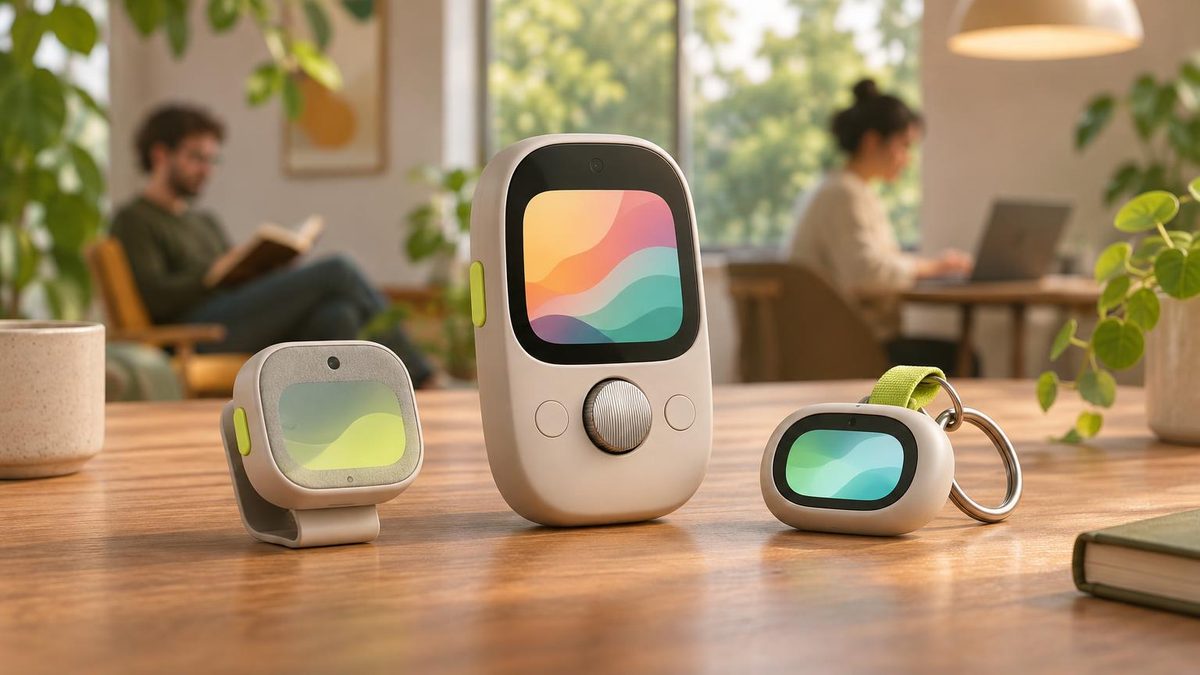
The Muse Charm looks closer to the R1 than the Pin: a palm-sized puck with a small screen showing an animated avatar, a fingerprint sensor you tap to talk, cameras front and back and, per Bloomberg, a USB-C port and a wrist strap option. It is smaller and goes on a keychain. We do not know its battery life, weight or chip, and Meta was still finalising the internal layout in September. Judge it on paper only for now.
Edge: tie between Muse Charm and Rabbit R1, because both use a screen and a simple button, which the Pin's projector showed is the safer choice. The Charm wins on size; the R1 wins on being a finished, known product.
What the AI actually does
This is where the gap is widest. The Pin answered questions, took photos and sent messages, but could not reliably do things for you. The original R1 promised to use apps on your behalf and mostly could not.
Muse is a different kind of software. Meta says it books travel, fills in forms, sends email, shops through connectors like Walmart, Best Buy and Instacart, pays with a one-time card through Link by Stripe, and keeps working after you close the app. Zuckerberg said in October that more than 10 million people had set it up and about a quarter use it daily, with shopping the top use. The Charm is just a faster way to reach that agent, which you can read about in our explainer on what Meta Muse is. One real gap: Amazon blocked Muse from shopping on Amazon.com in September.
Rabbit's OS3 is the closest rival. It can control a computer you connect, run on your choice of model and reach you on Telegram or by text. It is more flexible for tinkerers, but it is smaller, Rabbit's terms still call parts of it a technical preview, and some R1 buttons now need an OS3 account plus a computer that is switched on.
Edge: Muse Charm, because the agent behind it is the most capable and most widely used of the three, even before the device ships.
Software support and how long it will last
Humane is the warning. A device that only works through its maker's servers lasts only as long as that company. After the HP deal, the Pin died in ten days.
Rabbit has a better record than its reputation suggests: frequent updates through 2026, and the R1 works with OS3. But with production ended, long-term R1 support is a question mark.
Meta has the money and a product, Muse, that it clearly plans to keep. But the Charm specifically is not safe just because Meta is big. Bloomberg reported that CTO Andrew Bosworth called it an "exploration" and a "classic v0," and said phones and glasses will carry far more Muse use. Meta has killed hardware lines before. If the Charm does not sell, a second model is not guaranteed.
Edge: Muse Charm, because the software behind it has the strongest backing, with the caveat that Meta openly treats the device itself as a test.
Privacy and trust
All three are cloud devices with microphones and cameras. Humane added a "Trust Light" that showed when it was recording, and deleted customer data when it shut down.
Meta's pitch for Muse is detailed: each user gets a cloud virtual machine, a separate "Sentinel" agent must approve anything Muse sends to the internet, purchases need your approval, passwords and card numbers are hidden from the agent, and Muse data is not shared with Meta's ad systems. You can opt out of training. The Charm adds a fingerprint check before it accepts commands. But Meta has admitted, as reported by Wired and TechRepublic, that the current Secure VM is not technically inaccessible to Meta, and its promised Confidential VM had not launched as of November 28. Given Meta's history, a lot of people will want that fixed first.
Rabbit had its own security scare in June 2024, when a group of developers called Rabbitude said they found hardcoded API keys in its code (Rabbit rotated the keys and said it saw no evidence customer data leaked), and its new agent can be given access to your computer, which deserves care. Our guide to always-listening AI wearables and privacy covers the settings to check on any of these.
Edge: tie, because Meta offers the most safeguards on paper but asks for the most data, while Rabbit asks for less but has a thinner security record.

Does any of them replace your phone?
Humane said yes, and that was the mistake. The Pin had its own number and wanted to be your main device, so it had to beat a smartphone. It could not.
Rabbit said no, the R1 is a companion, and that was more honest. Meta says no too. Bloomberg reports the Charm cannot make normal phone or video calls and pairs with the Muse app on your phone. Zuckerberg pitched it only as the fastest way to talk to Muse when you are not wearing glasses. If your phone already does the job, our guide on whether you need an AI gadget at all is worth five minutes.
Edge: Muse Charm, because it is built around a clear, narrow job instead of an impossible one.
Five lessons from the first wave of AI gadgets
- Software first, hardware second. Humane and Rabbit shipped the gadget and hoped the AI would catch up. Meta launched Muse, waited for millions of users, then announced the Charm.
- Do not fight the phone. A small device wins by being faster for one thing, not by replacing everything.
- Be clear about the monthly bill. Humane's required $24 plan hurt. Ask what the Charm's data costs after the free year before you buy.
- Servers decide lifespan. A cloud gadget can stop working the day its maker changes plans. Check what still works offline.
- Agents need trust. An assistant that spends money needs approvals, audit trails and a maker you believe. Muse has the first two.
Which one should you buy?
- Do not buy a Humane AI Pin. Any you find second-hand no longer connects to anything. At best it is a collector's item.
- Buy a Rabbit R1 ($199) only if you like tinkering, want Rabbit's OS3 agent on a physical button, and accept that production has reportedly ended.
- Wait for the Muse Charm if you already use Muse daily and do not wear Meta glasses. Wait for real reviews, a confirmed price and the true data cost after the free period.
- Buy nothing yet if you have not tried Muse on your phone. The app is free, and it will tell you quickly whether a dedicated gadget would help.
FAQ
Does the Humane AI Pin still work?
No. Humane shut down its servers at noon Pacific time on February 28, 2025. Calls, messages and AI features stopped and customer data was deleted.
Is the Rabbit R1 still worth it in 2026?
Only for enthusiasts. It costs $199, now runs Rabbit's OS3 agent, and gets updates, but Wired reports Rabbit has stopped making it and there is no R2 planned.
Is Muse Charm better than the Rabbit R1?
On paper, yes, because Meta's Muse agent is more capable and widely used. But the Charm is not out yet, so there are no independent reviews to confirm it.
Who bought Humane?
HP, for $116 million, announced in February 2025. HP got the Cosmos software, patents and staff, not the AI Pin business.
More on AI gadgets
Sources
Checked on November 28, 2026.
- Meta: The Biggest News From Connect 2026
- Meta: Introducing Muse
- TechRepublic: Meta Previews Muse Charm
- Engadget: Meta's Muse Charm will reportedly cost $300
- TechCrunch: Meta says Muse has over 10M users
- Android Authority: Humane AI Pin shut down
- Tom's Hardware: HP buys Humane for $116 million
- Liliputing: Humane AI Pin gets a $200 price cut
- Android Authority: Humane AI Pin specs and price
- 9to5Google: Rabbit R1 AI companion
- Rabbit: r1
- Rabbit support: What is rabbit OS3
- Rabbit community: rabbitOS release notes
- iTechPost: Rabbit OS3 launches, citing Wired on R1 production
- Tom's Guide: Humane AI Pin review roundup
- Engadget: Rabbit R1 security issue allegedly leaves user data accessible
- GeekWire: Amazon blocks Meta's Muse AI assistant